Published: Oct 13, 2026
Updated: Oct 13, 2026
| Name | Anonymous |
|---|---|
| Age | In their 30s |
| Concern | Concerned about the front hairline and the M-shaped areas, and about the sides and back puffing out as the hair grows |
| What he asked for | Wants the sides and back short and neat, and the front hairline covered naturally using his usual hair flow |
| Everyday styling | Wets the hair in the morning and styles it with a dryer. Barely uses styling products |
Tidying an M-shaped hairline and bulk at the sides naturally with a very short cut that works with the growth pattern
Our client this time is a man in his 30s who is concerned about his front hairline and the M-shaped areas.
When we asked in the consultation what bothered him most, the first thing he named was his front hairline.
He usually sweeps his fringe to one side, which covers the M-shaped areas naturally.
At the same time, he has a fair amount of hair at the sides and back, and it tends to puff out as it grows. That is another concern.
The back of his head in particular has an unusual growth pattern: at an in-between length, the hair gets pushed up and tends to stick out.
So this time, rather than trying hard to keep just the M-shaped areas out of sight, we worked from these ideas:
- Keep the sides and back short to hold down the width
- Cut to a length where the growth pattern is less likely to stick out
- Work with his usual flow for the fringe
- Keep the weight needed where the hair covers the M-shaped areas
With that approach, we finished with a very short cut that is also easy to style every day.
The consultation: the front hairline, and bulk at the sides and back

Right now, what concerns him most is his front hairline.
He styles it every day by sweeping the fringe to one side so that it covers the M-shaped areas naturally.
That flow suits his current hair type and the way it grows, so there is no need to force it in a new direction.
For the sides and back, on the other hand, he said he prefers them neat.
He was fine with the lower back going short enough for a little scalp to show, and wanted a fade that gets gradually longer from there upward.
It had been a little under two months since his last cut. We trim the growth and make the silhouette more compact, mainly at the sides and back.
The cut: deciding where to go short and where to keep weight
① Short sides and back to keep the width down
The biggest adjustment this time is at the sides and the back of the head.
When thick hair at the sides grows out, the whole silhouette of the head spreads sideways.
So we keep the lower part short and neat and blend it into a fade that connects naturally upward.
Keeping the width compact also makes it easier to balance the fringe and the top when seen from the front.
② At the back, a length where the growth pattern is less likely to stick out
At the back of his head, there is an area where the hair grows in a slightly different direction from the usual flow.
Kept fairly short, it is no problem. But at an in-between length, the hair underneath pushes up, and it tends to stick out or puff up.
He told us that as it grows, the growth pattern at the back does bother him, and he sometimes tidies it himself.
A growth pattern cannot be removed, so instead of forcing it down, we take the hair short enough that sticking out is less noticeable.

③ Do not make the fringe that covers the M-shaped areas too light
He usually sweeps his fringe to one side to cover the M-shaped areas.
This time we keep that flow as it is.
The key is not to make the fringe too light.
In the consultation, too, we judged that leaving a little weight around the fringe would make it less likely to split.
Taking out more hair than needed around the M-shaped areas can make the fringe split more easily and the hairline show more.
So where the hair is needed to cover the hairline naturally, we cut it leaving a moderate amount of weight.
④ When it comes to thickness, lighter is not always better

Partway through the cut, he also asked for the sides and back to be a little lighter.
But taking out a lot of bulk does not always make hair sit better.
If too many short hairs are created underneath the longer hair, they push the longer hair up as they grow, and the silhouette can end up puffing out instead.
Especially when, as here, there is a lot of hair at the sides and a growth pattern too, it is important to adjust the thickness with an eye not only on how light it feels but on how it will look as it grows.
Before and after from four angles: a very short cut that works with the growth pattern
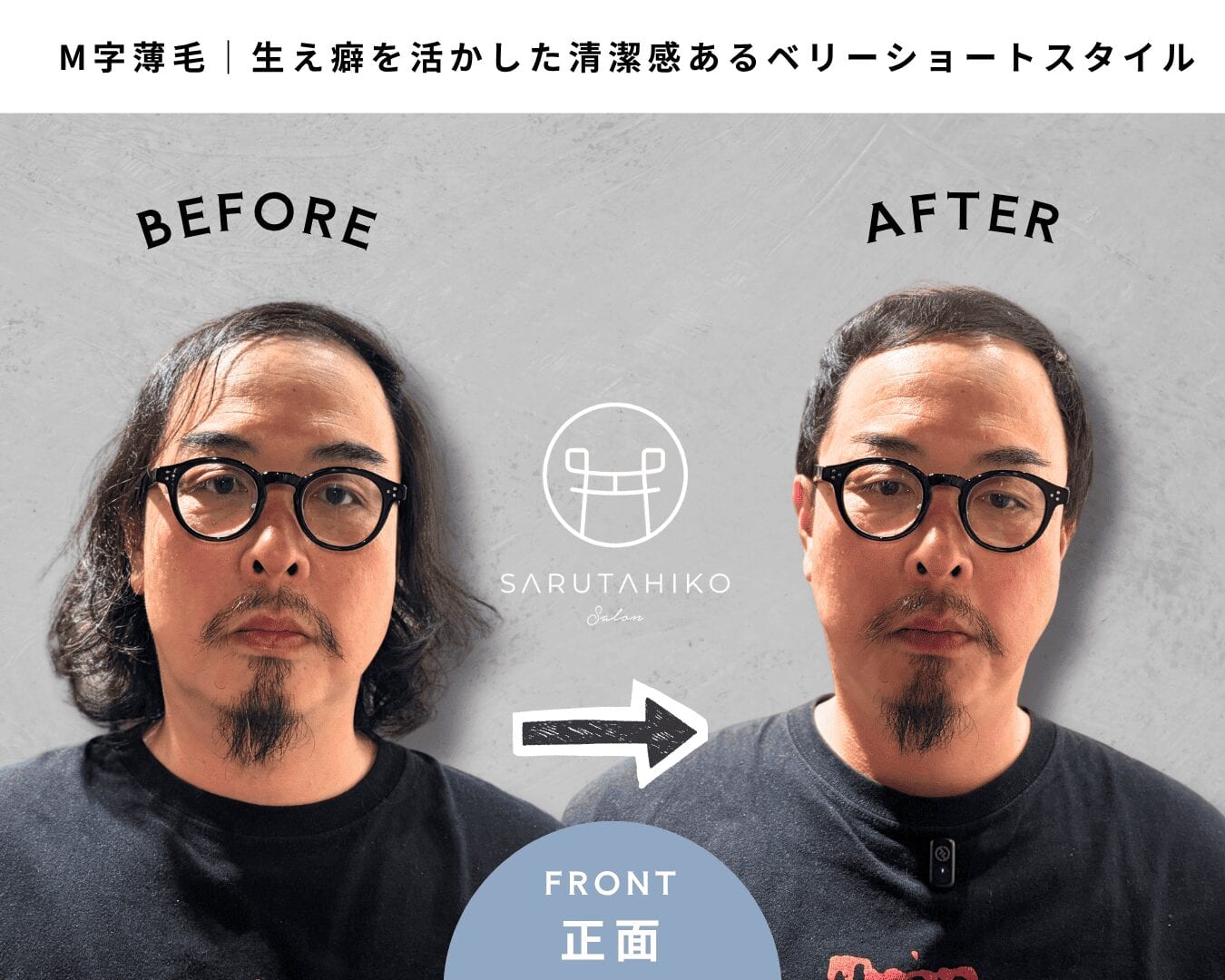
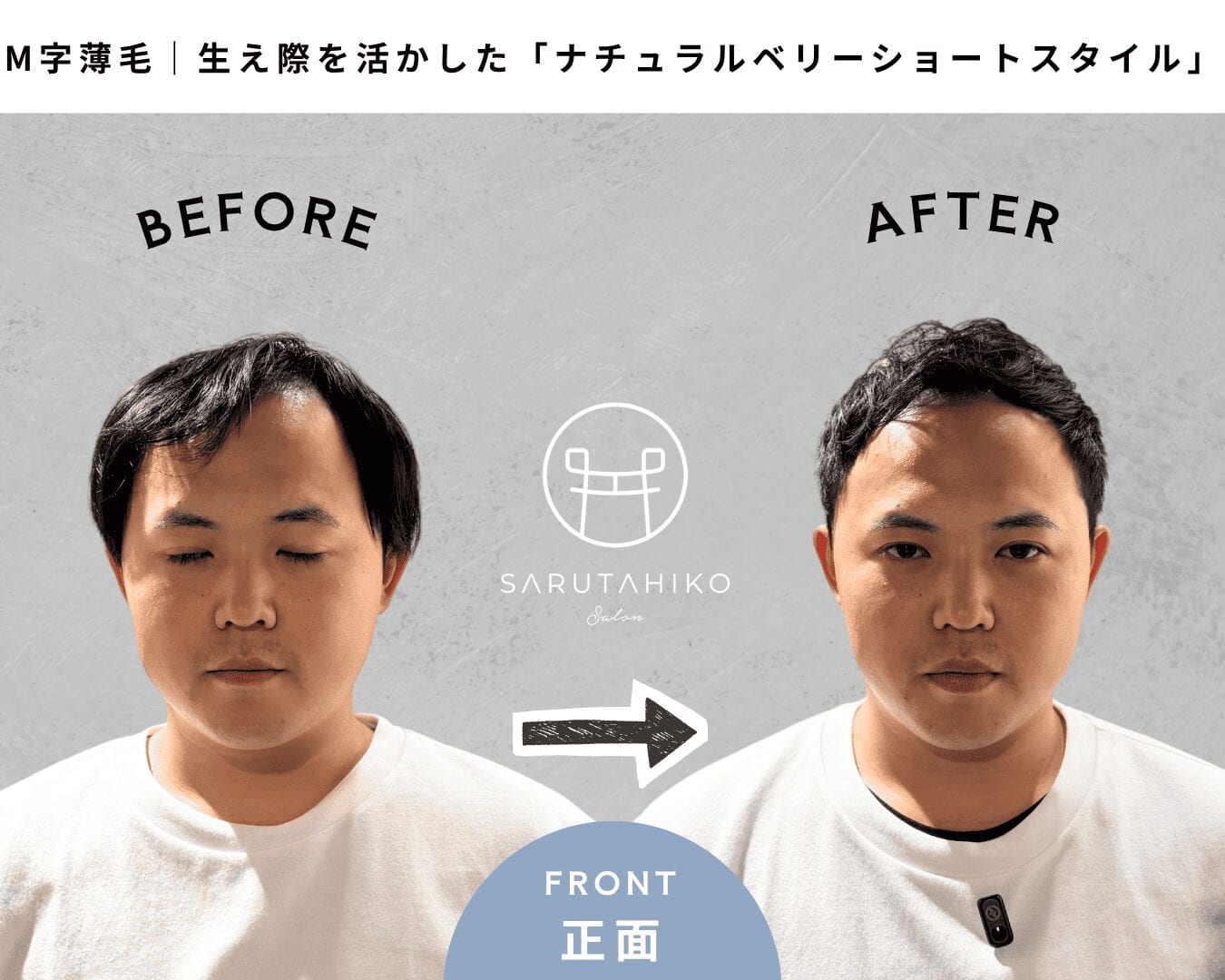
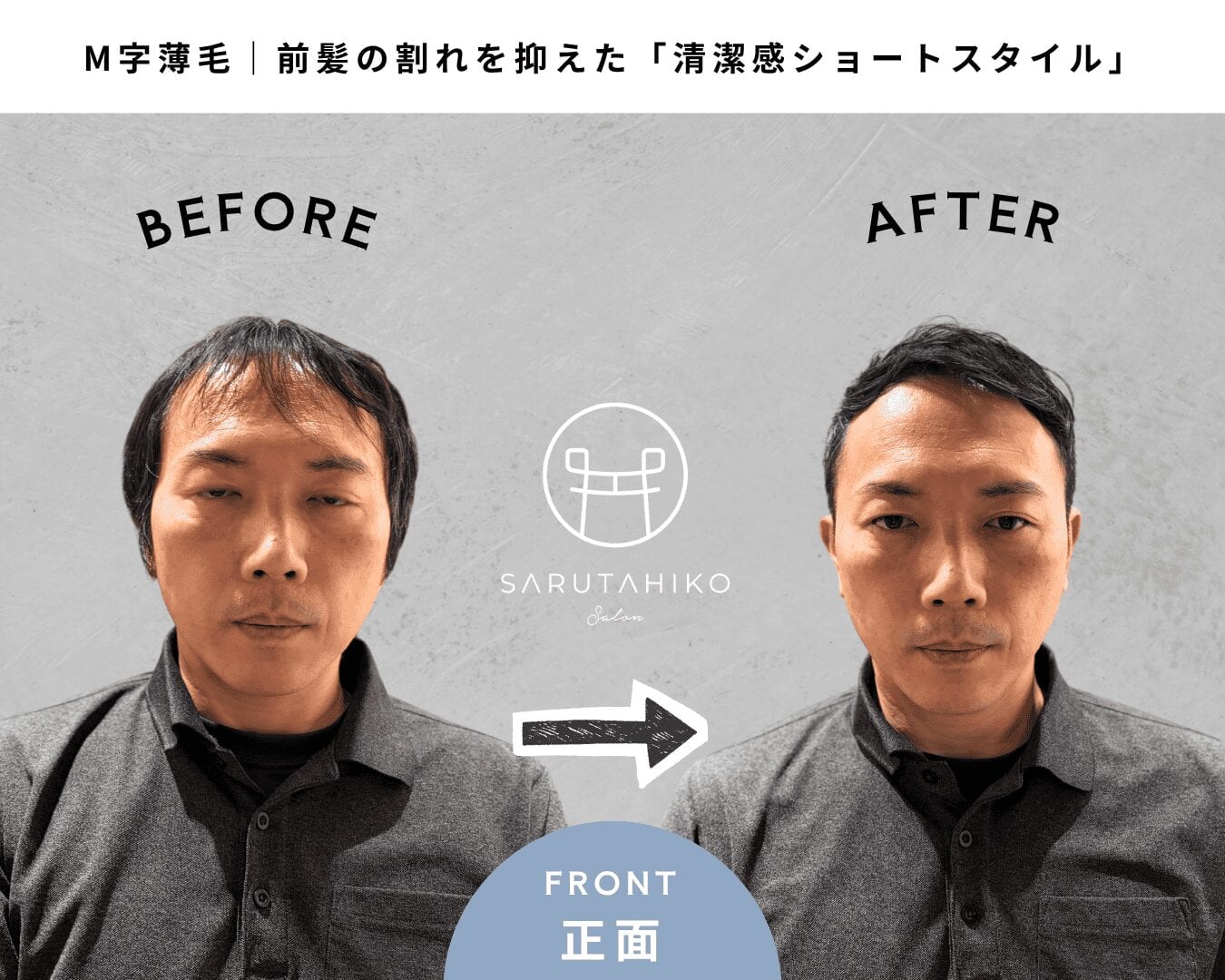
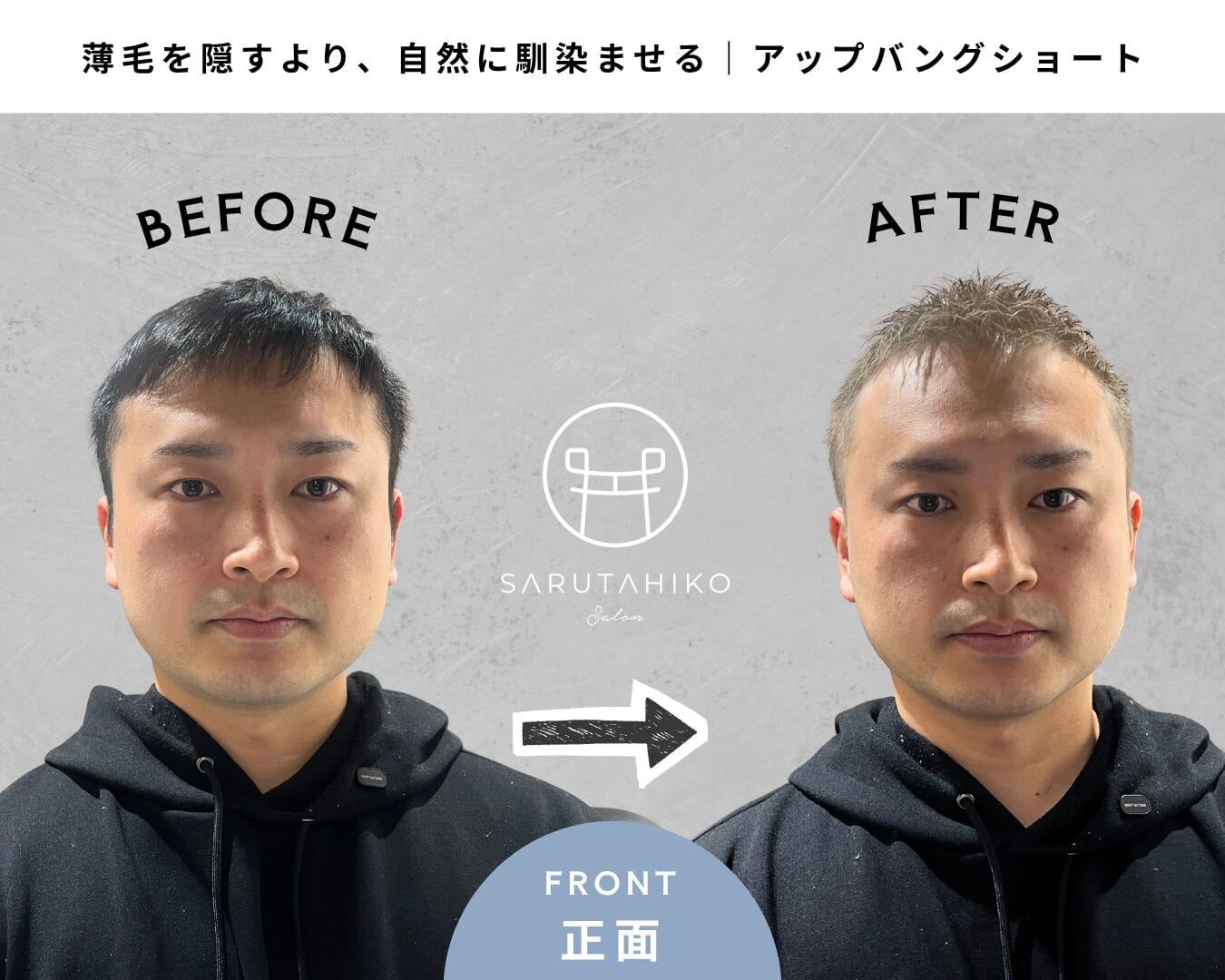
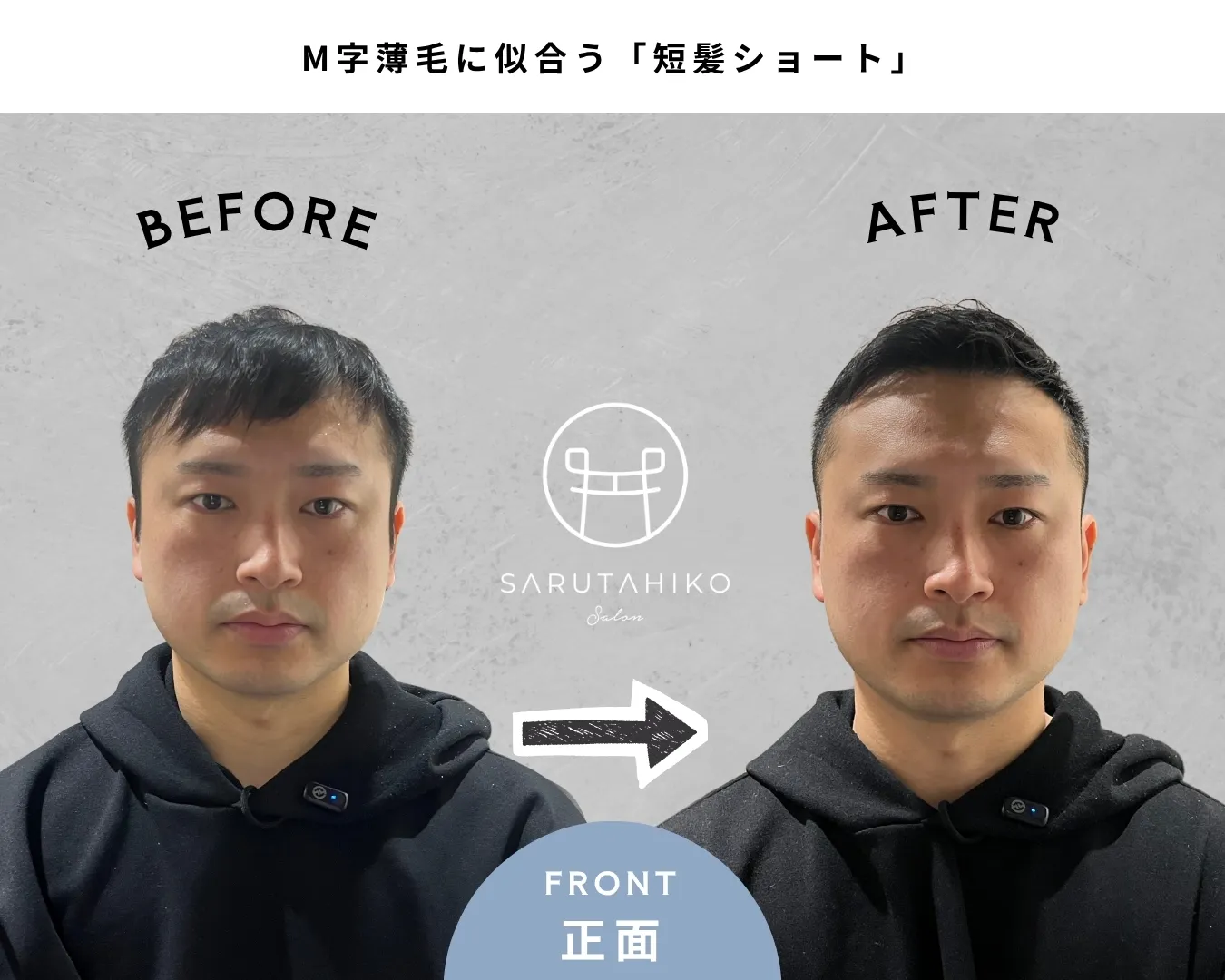
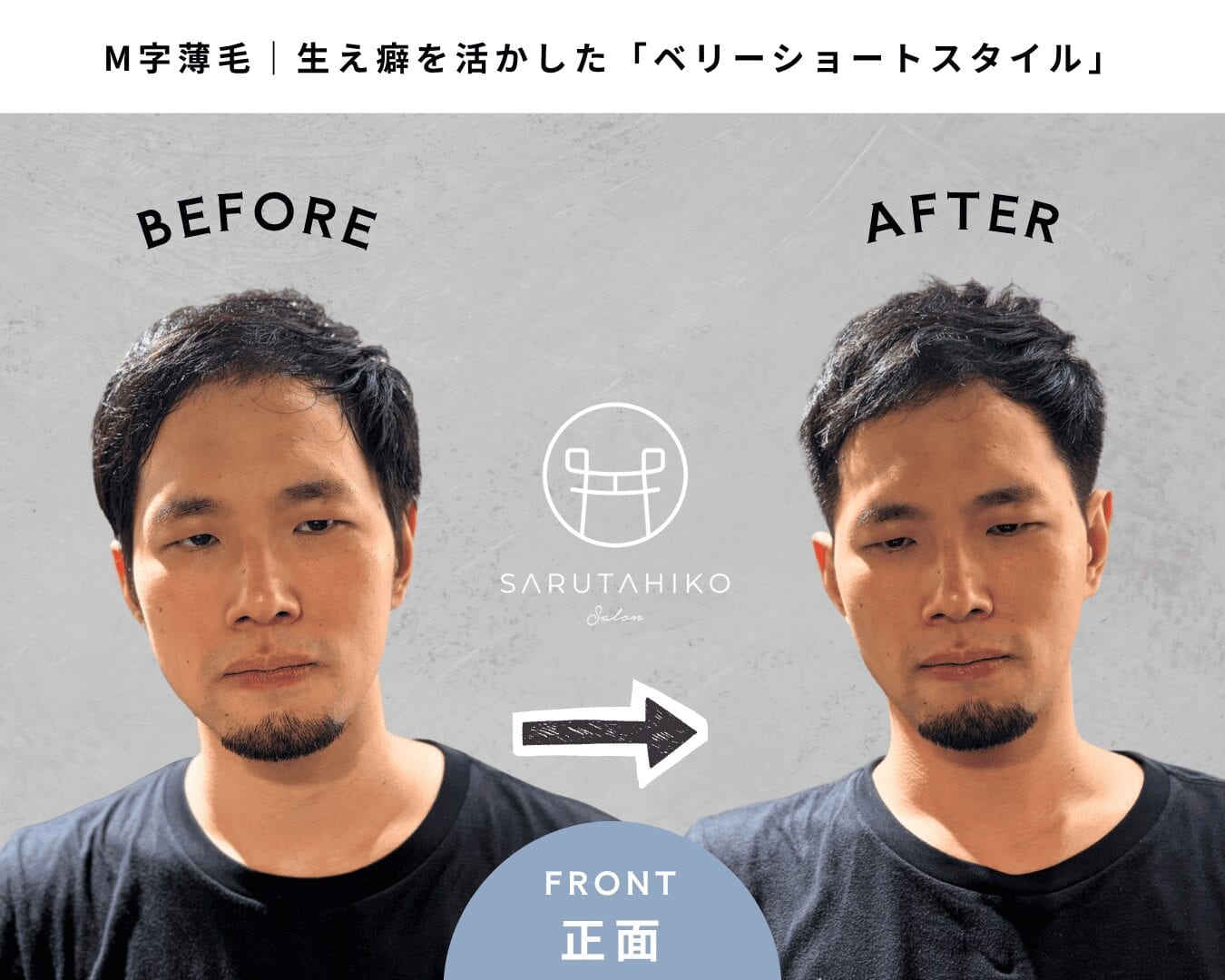
Front: the M-shaped areas covered naturally using his usual flow

From the front, the cut works with the fringe flow he was already using.
Rather than gathering the fringe to hide the hairline, we kept the weight the M-shaped areas need and let it fall naturally to the side.
Shortening the sides also brought the width in, and the area around the face looks neater.
Right side: less bulk, a more compact shape

Shortening the sides made the width, which had puffed out as it grew, more compact.
We adjusted the length so it connects naturally from the top to the back, and finished it so it does not look cut too short.
Left side: tighter sides to shape the overall silhouette

On this side too, we took down the volume at the side so the head does not look wide.
So that attention is not drawn only to the front, the M-shaped areas blend in naturally through the balance of the whole head.
Back: a short fade to settle a growth pattern that sticks out easily

Because of the way the hair grows there, the back is an area where it gets pushed up and sticks out as it grows.
This time we took the lower part short and graduated it naturally upward, which makes the growth pattern less noticeable without forcing it down.
With a growth pattern like this, it is important to cut with an eye not only on the hair type but on the length at which it starts to stick out.
Watch the video: a very short cut that covers an M-shaped hairline naturally, for a man in his 30s
Here is the video of this client's cut. Along with the before-and-after photos from four angles, take a look at the natural flow at the hairline and the neatly tidied sides and back.

If the video does not appear, use this link: Watch the haircut video on YouTube
Easy to style, even if you do not usually use wax
This client barely uses styling products day to day.
In the morning he wets his hair, then uses a dryer to sweep the fringe in its usual direction.
When we asked why he does not use products, he said it is too much hassle.
So rather than a cut that only works with careful wax styling every morning, we made one that fits the routine he already has.
Easy styling at home
- In the morning, wet all of your hair
- Towel off the excess water
- Blow-dry the fringe in the direction you usually sweep it
- Dry the sides while pressing them down with your hand
- Use your fingers to add a little volume on top
- If needed, use a powder mist
That is basically all there is to it.
The styling product we used: Powder Shake
This time we used Powder Shake, a mist you apply to wet hair before drying.
You work the mist, which contains a powder ingredient, into towel-dried, still-damp hair and then blow-dry it as is.
It does not make the hair sticky and stiff like ordinary wax. Instead, you can use it as a base product that gives the roots some body and helps the hair lift and stay in place.
For the finish, we simply worked the mist through all the hair and blow-dried it, yet the top was easy to lift with the fingers and the fringe easy to arrange.
It is not very sticky either, so it is an easy method to adopt if you do not usually use wax or do not want to spend time styling every morning.
With an M-shaped hairline, the key is not to think only about the fringe
When an M-shaped hairline bothers you, it is easy to think only about how to hide it with the fringe.
But how it actually looks is not decided by the fringe alone.
- width at the sides
- volume at the back of the head
- weight in the fringe
- length on top
- amount of hair
- growth pattern
- usual hair flow
- everyday styling
Balancing these across the whole head can give a natural look without forcing the hairline out of sight.
In this case, too, we did not dramatically change the M-shaped areas themselves.
By tidying the sides and back, keeping the weight the fringe needs and working with his existing flow, we arrived at a natural very short cut.
This style suits you if
- you are concerned about an M-shaped hairline or thinning at the hairline
- the hair at your sides puffs out easily
- you have a cowlick or an awkward growth pattern at the back of your head
- you like very short or short cuts
- you don't want to use wax every day
- you want your morning styling to be simple
- you don't want it to look as if you are trying hard to hide your thinning hair
Even with the same M-shaped hairline, the right length depends on hair type, amount of hair and growth pattern.
For some people a shorter fringe looks more natural; for others, as here, it is better to leave some weight where it is needed.
What a barbershop for men with thinning hair can offer
At SARUTAHIKO we do not judge by the pattern alone — M-shape, O-shape, horseshoe. We look at your hair, how it grows, the shape of your head and how you live, and propose from there.
Not simply cutting it short or growing it to hide anything, but
- where to cut short
- where to keep length and weight
- which way to sweep the hair
- how to recreate it at home
- how it will look as it grows out
are all part of the cut.
If you are thinking "my M-shaped hairline bothers me and I do not know what style to choose," "my sides puff out and my hair will not settle," or "I want a style that works without wax," come and talk to us.
FAQs
- With an M-shaped hairline, is a longer fringe better for covering it?
- Longer is not necessarily better. If the fringe gets too long, the hairline can become noticeable when the fringe splits or moves. What matters is finding a length that lies naturally over the hairline, based on the flow and the amount of hair.
- If the hair at the sides puffs out, should I have a lot of bulk taken out?
- Take out too much and the short hairs left underneath push the longer hair up as they grow, which can make the silhouette puff out instead. It is important to adjust while checking not just the amount of hair but the growth pattern and how the layers sit.
- Can I style this cut without wax?
- This client barely uses wax either. The basics are wetting the hair in the morning and shaping the flow with a dryer. If you want more volume or hold, you can also add a powder mist like the one we used here.
- Can a cut fix a growth pattern?
- The growth pattern itself cannot be changed. But avoiding the lengths at which it sticks out, and cutting to match the direction it grows, can make it easier to manage.
- How often should I get a cut?
- This client comes in for a cut roughly once every two months. When the sides or back start to puff out, or the growth pattern starts making the hair stick out, that is also one sign it may be time for a cut.