Published: Sep 6, 2026
Updated: Sep 10, 2026
| Name | Anonymous (Mr A) |
| Age | In their 40s |
| Concern | The fringe is thinning and the hairline is slowly receding. When the fringe splits, the M-shaped area shows. |
| Everyday styling | Barely uses styling products; usually leaves the hair dry in the morning. Comes in every two to three months. |
| Other | No objection to short cuts or a taper. Wants a clean short style he can manage in about five minutes in the morning. |
"My fringe splits and the M-shape shows." The real concerns of men in their 40s
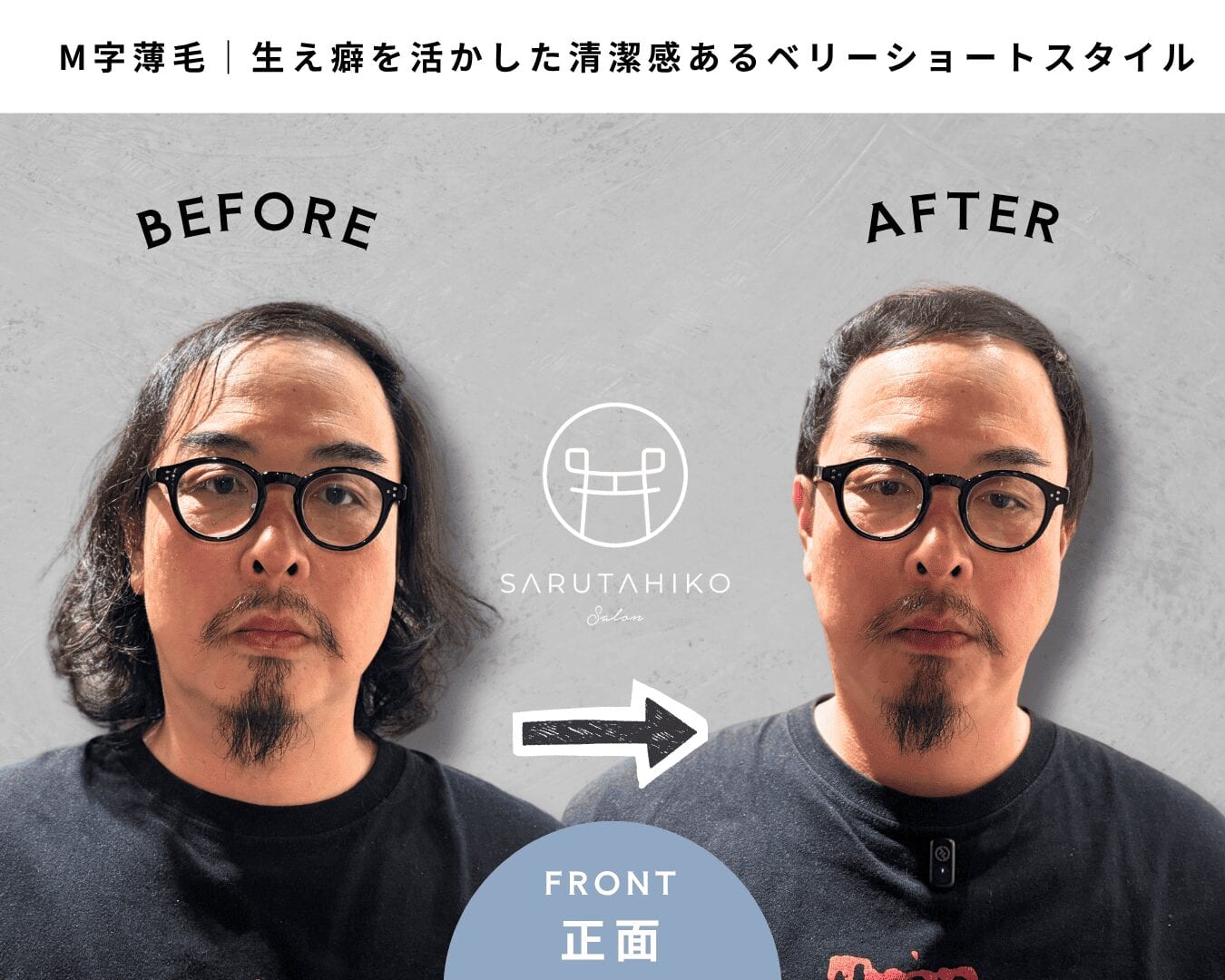
Our guest this time was a man in his 40s, concerned that his fringe had thinned and the hairline was slowly moving back.
What troubled him most was that the M-shaped area became easy to see whenever the fringe split. He had kept the fringe long, but the length made it move, and the hairline showed through the parting.
The top had grown long and was hard to give volume, while the sides swelled outwards, which made the top look even lower.
He barely uses styling products and usually leaves his hair as it is in the morning. So we aimed for a short style that looks clean without much work, and that can be reproduced in about five minutes when needed.
We go over what concerns you in the consultation beforehand

In the consultation we checked the splitting fringe, how the M-shaped area reads, the volume on top, the width at the sides, and the silhouette at the back.
Leaving the fringe long to cover tends to make it split when you move, which draws the eye to the M-shaped area instead. So we suggested trimming the fringe to a length that is easy to handle, and balancing it so it can be lifted or swept slightly rather than laid flat to hide anything.
So we did three things:
· Trim the overgrown fringe to a manageable length · Clean up the sides that swell, to contrast with the top · Keep natural height on top · Leave roundness at the back so the head shape reads well
Rather than covering only the fringe, we worked from shaping the silhouette of the whole head so the M-shaped area blends in naturally.
Key points of the cut
The key this time was not to force the M-shaped area out of sight, but to let the fringe, top, sides and back work together.
We trimmed the overgrown fringe to a length that does not split when it moves. Cutting the sides short holds down the width, so the top gains height by comparison.
We did not cut the back too short, leaving enough roundness where it can look flat. For styling, dampen the hair lightly, dry it lifting the roots, and add a small amount of product if needed. It is built to be reproducible in about five minutes.
The result

What we aimed for was not a style that hides the M-shaped area behind the fringe.
By trimming the fringe that had grown long and was splitting, keeping the sides compact and giving the top natural height, we built a balance where the eye does not settle on the hairline alone.
Leaving the necessary roundness at the back also keeps the head shape natural from the side, not only from the front. Short, tidy sides make a clean impression easier to achieve.
Quite a few people keep the fringe long because the M-shape bothers them, only to find that the longer it gets, the more it splits and shows the hairline.
Adjusting the length of the fringe, the height on top and the volume at the sides can make things look natural without forcing anything out of sight.
If a splitting fringe or how the M-shaped area reads is on your mind, please come and talk to SARUTAHIKO.

What a barbershop for thinning hair can offer
At SARUTAHIKO we work from the characteristics of each pattern — M-shape, O-shape, horseshoe (U-shape) — and build the style from there.
Rather than simply cutting it short or covering it up, we look at
- Where to add volume
- Where to keep it tight
- What to show
- What to soften naturally
are part of the plan as well.
We also cover more than the cut itself:
- How to style it
- Choosing a wax
- How to use a dryer
- How it grows out
and propose the style on that basis.
"I do not know what would suit me." "I cannot get any volume." "It was hard to bring this up at an ordinary salon."
If any of this sounds familiar, please feel free to talk to us.

.

.

.

FAQs
- I am not good with my hands. Will I be able to style it at home?
- We cut with reproducing the style at home in mind. We show you approachable steps, such as how to aim the dryer and how to work in a small amount of wax at a time.
- I have no idea what would suit me.
- That is all right. We look closely at your head shape, hair texture and the pattern of thinning — M-shape, crown and so on — and propose the style that balances best.
- My fringe splits open and the scalp shows. Can that be fixed?
- Adjusting the length and weight of the fringe and cutting to work with the way it grows can make the splitting less noticeable. We keep the thickness you need while aiming for a fringe that is easy to handle and settles well.
- My hair is thinning and has no volume. Can a cut alone really change that?
- A cut alone can change how it reads. Tightening the areas that swell and adjusting how the hair layers and flows around the top makes natural volume easier to achieve without a perm.