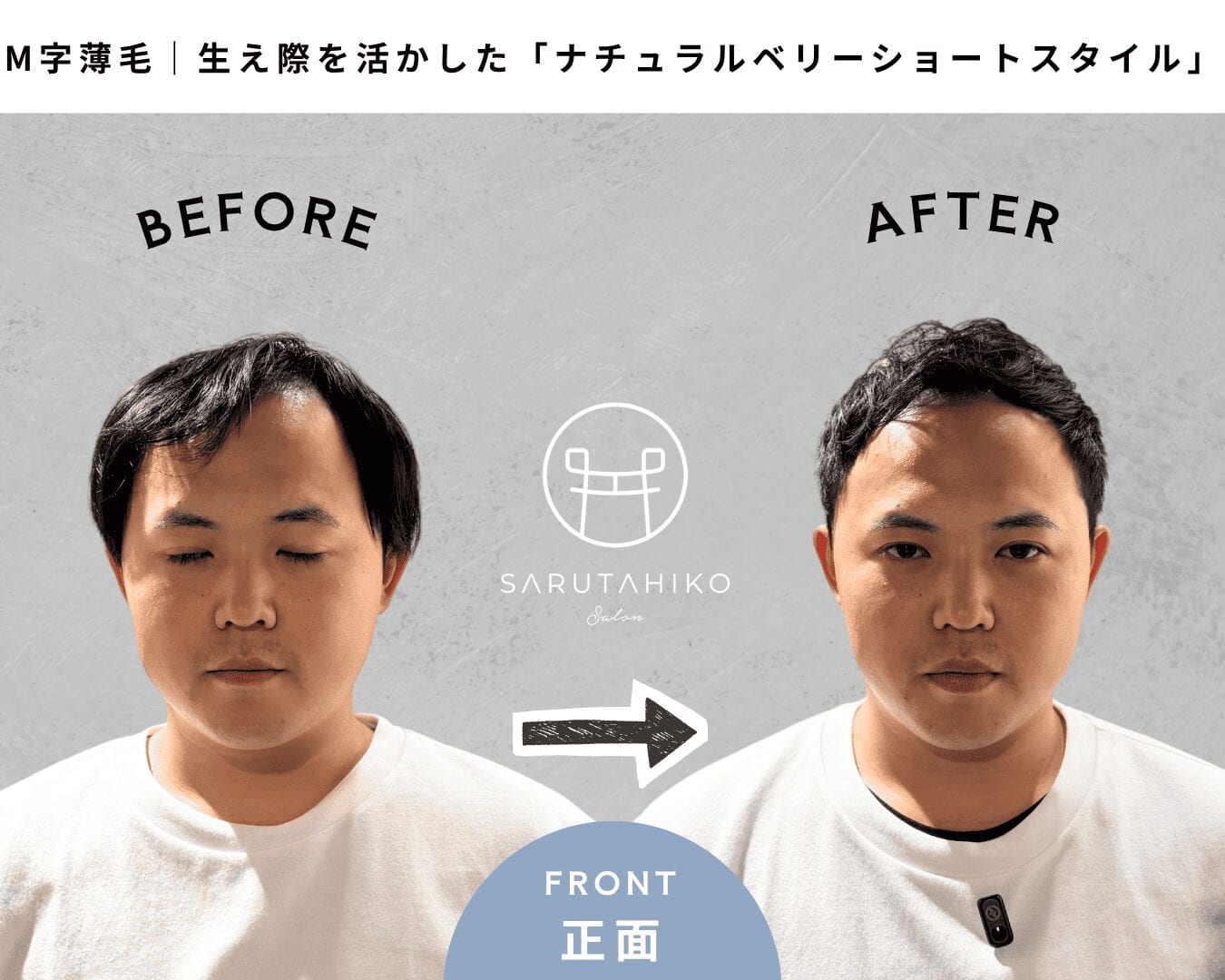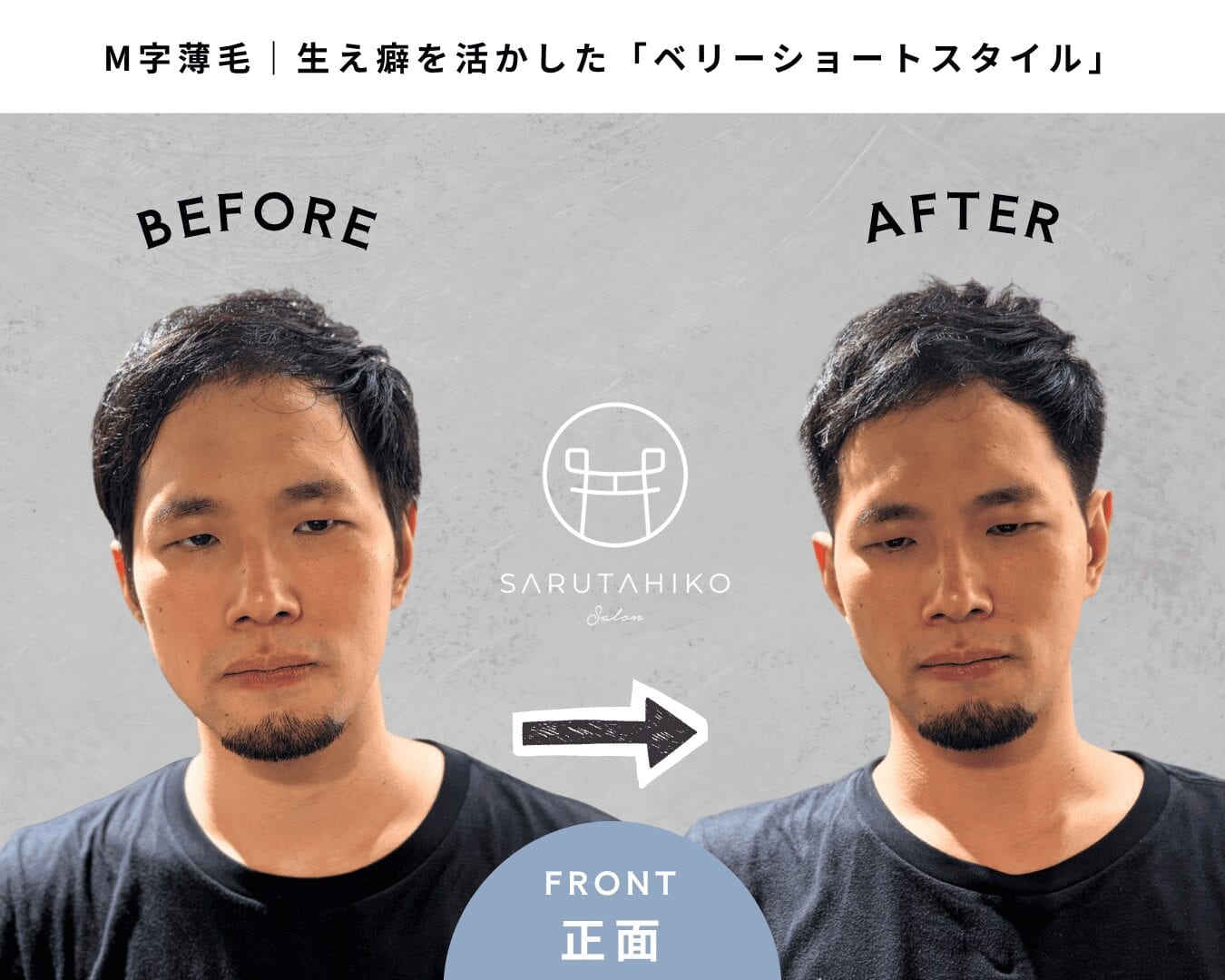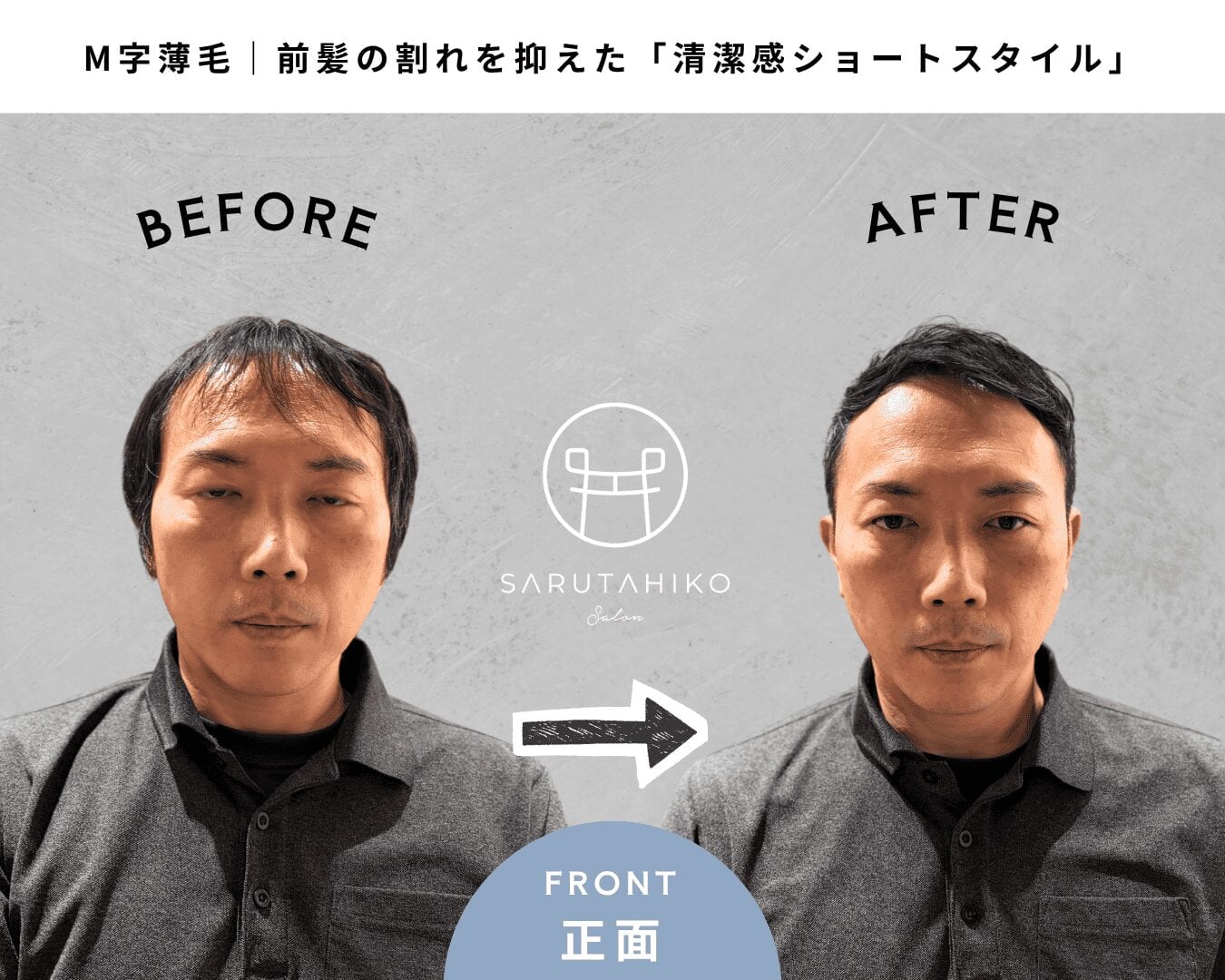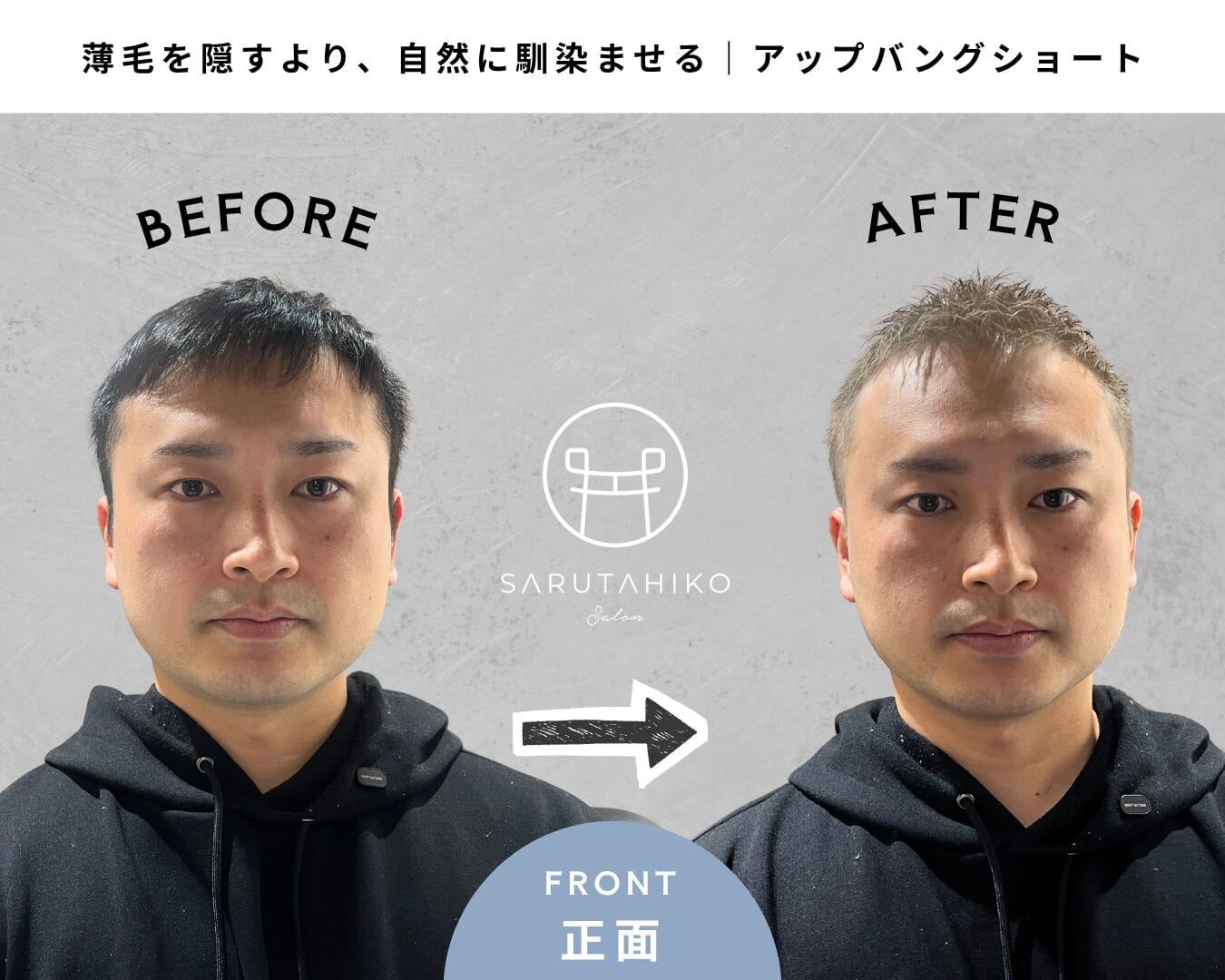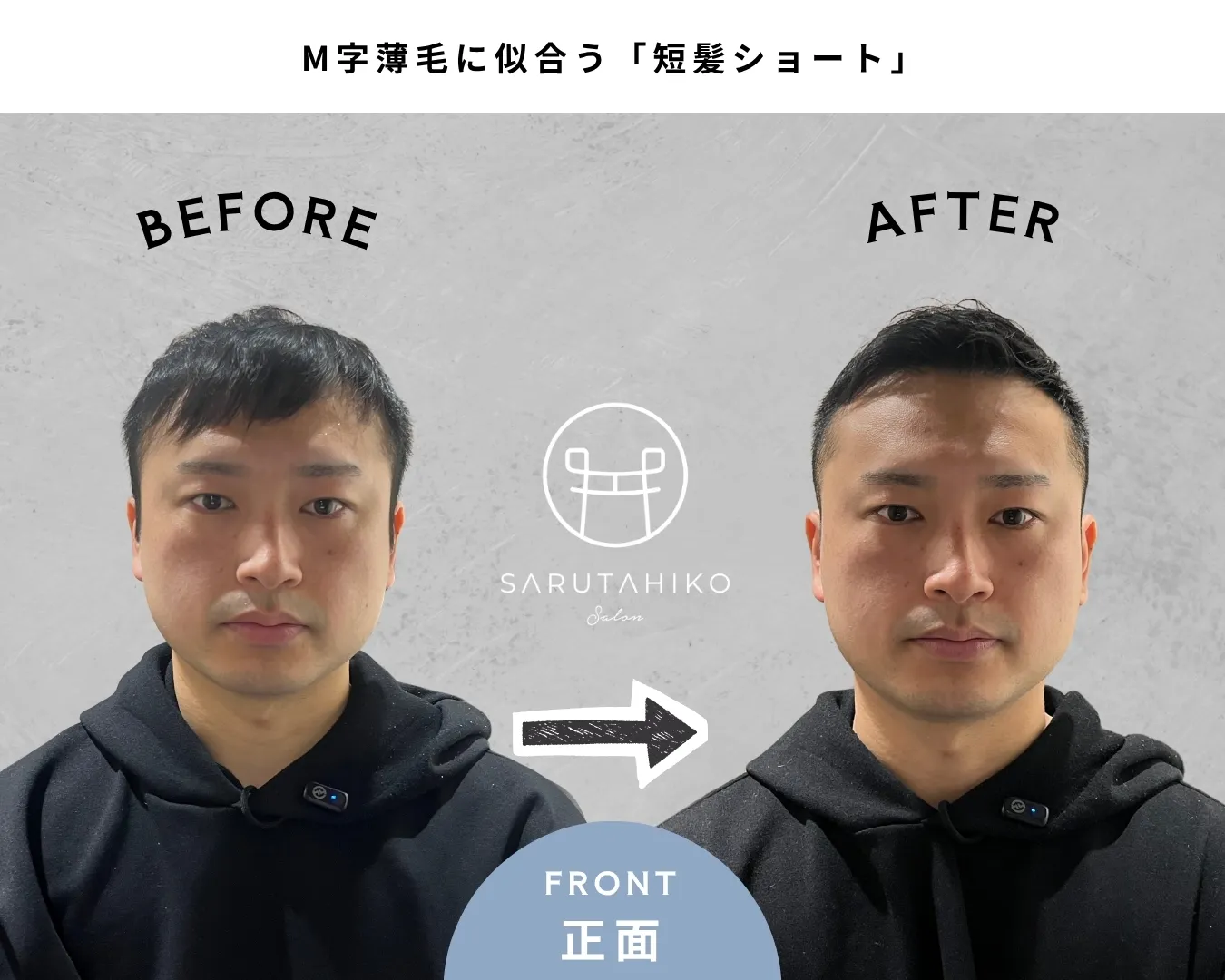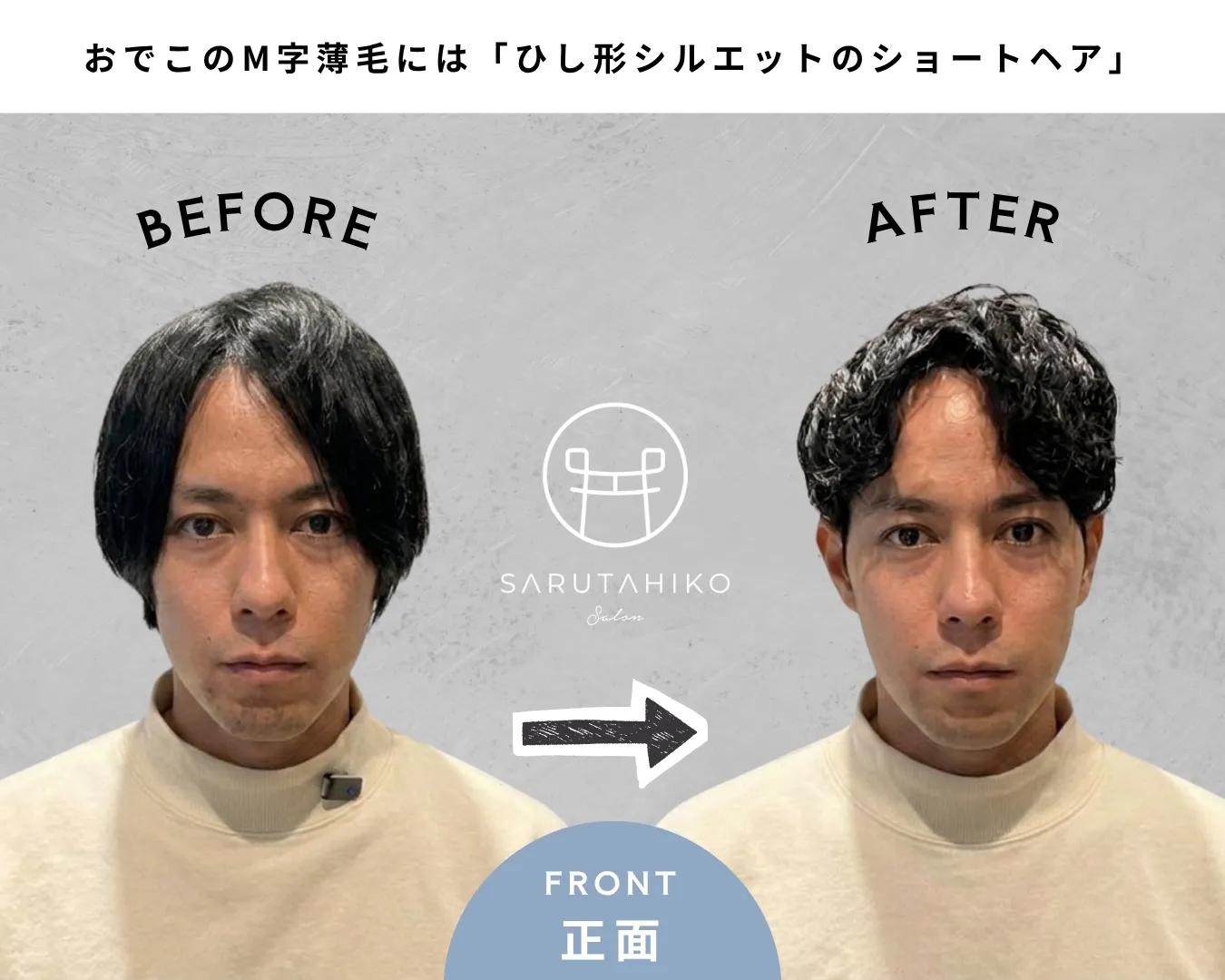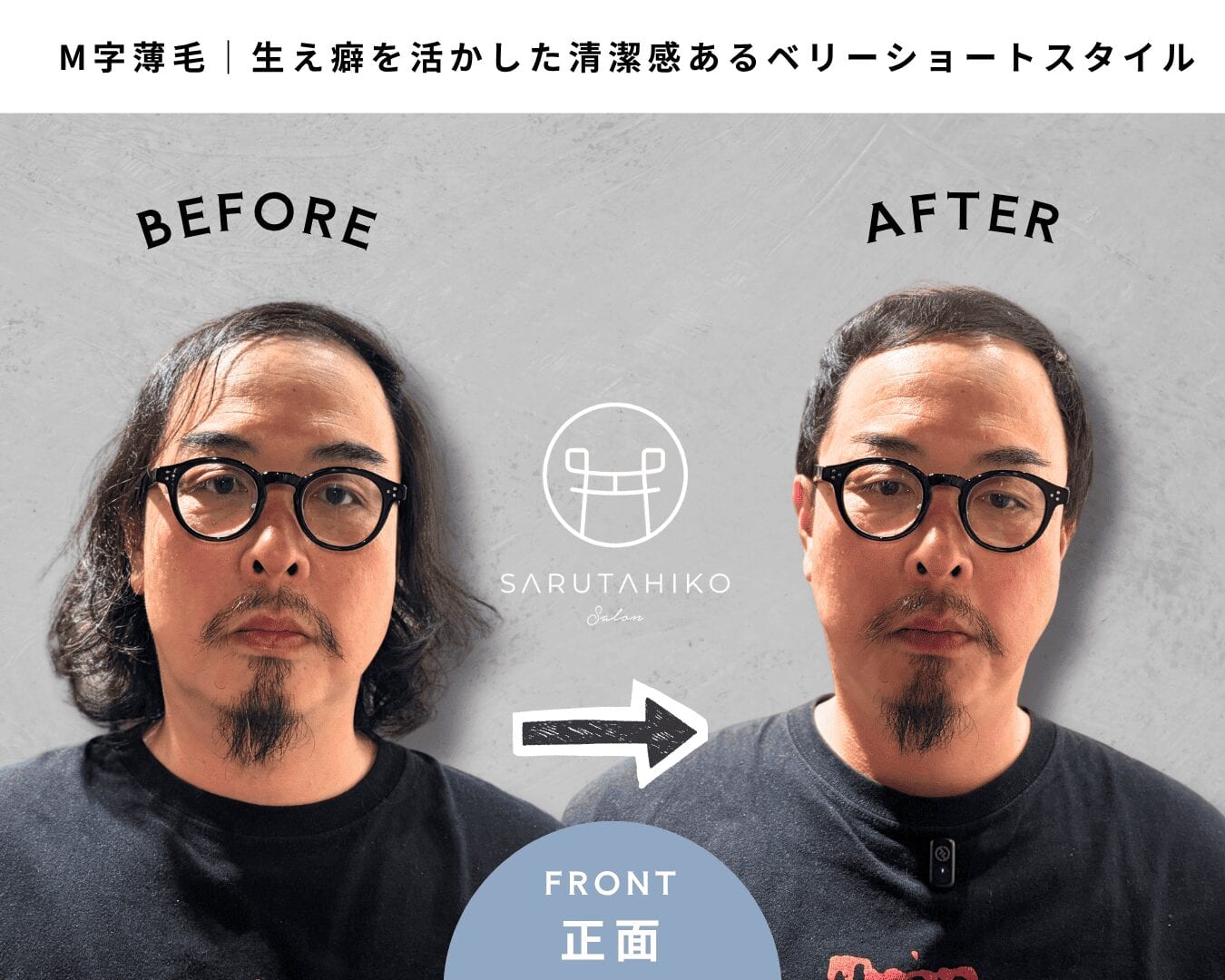
Even if an M-shaped hairline and bulk at the sides bother you, tidying the length and flow lets us aim for a clean, natural look. Here is a real cut for a man in his 40s whose hair had been growing for about a year. We tidied it up and worked with the flow from his whorl and the length on top, so the scalp on top, which bothered him, shows as little as possible.
| Name | Anonymous |
|---|---|
| Age group | In their 40s |
| Type of thinning | M-shaped hairline, receding on both sides |
| Before the cut | No cut for about a year. The sides and nape were long, and the thinning on top and the visible scalp bothered him |
| Result | A natural short style that skips a tight clipper cut, sits just over the ears and keeps weight on top |
| What the photos show | With the long nape and sides tidied, the top and the overall silhouette look cleaner |
Working with an M-shaped hairline and the natural growth pattern: a real cut from longer hair to a clean short style
This client is a man in his 40s. His hairline has receded in an M shape on both sides. Before the cut, his hair was long from the fringe through the sides to the back.
In the consultation, he said he had felt a little embarrassed about going to a barber because of his thinning hair. He also said his hair had grown long over about a year without a cut. The thinning on top bothered him most, and he wanted a fresh, tidy look that showed as little scalp as possible.
So this time we went for a short style with no tight clipper cut: the sides sit just over the ears, and the top keeps the length needed to cover the scalp.
We checked the natural flow, which runs forward from the whorl, and adjusted the hair that had grown long enough to hang down. The idea is to build weight on top while making the area around the face and the whole head look lighter.
- Give the fringe a natural flow instead of trying hard to cover the M-shaped hairline
- Even out the weight at the sides to keep them from spreading outward
- Take the long nape shorter so the back of the head looks lighter
- Use the forward flow from the whorl to build weight and natural dimension on top
The consultation: his concerns and what he wanted from the cut
In the consultation, he explained that his thinning hair had made it hard to bring himself to visit a barber, and he had not had a cut for about a year. He had kept a buzz cut for a long time before that, so he did not know how to ask for a style. Without meaning to, he had drifted away from haircuts.
What he wanted was this: "I want it short and tidy, but I'd rather the scalp on top didn't show much." Because it bothered him, he often wore a hat and hardly used styling products. At the same time, he was willing to try a style that was easy to set.
He had had a short clipper cut before, but said it did not need to be that short this time. So the barber suggested a natural length that sits just over the ears.
In the consultation, we checked the flow at the whorl and agreed on a length that keeps the scalp on top less noticeable, even when cut short. We also considered how easy it would be to style every day.
Before the cut: long sides and nape, and an M-shaped hairline that bothered him

In the front photo before the cut, you can see the M shape on both sides of the hairline. The fringe and the hair around the ears are long, so the hair frames both sides of the face.
From the side, the hair over the ears and the length at the back add volume sideways as well. From behind, you can see the hair has grown long down to the nape.
This does not mean long hair cannot suit you. But when the weight at the sides or the way the hair grows is a concern, as here, sorting out the length can make daily styling easier.
Key points of the cut in photos: working with the M-shaped hairline and shaping the whole silhouette
① A natural flow for the fringe, without trying hard to cover the M-shaped hairline
With an M-shaped hairline, trying to cover both sides with a long fringe can actually look less natural, depending on the flow and the parting.
Here we adjusted the length of the fringe and the weight on top. This tidies the flow from the top into the fringe and gives a clean look around the face.
② Shorter around the ears and at the sides to keep the width down
Before the cut, the length over the ears and the volume at the sides stood out.
After the cut, the hair sits at a natural length just over the ears, and the outline from the side is more compact. The key is not cutting the top too short, so it stays in balance with the weight at the sides.
③ A tidier nape for a lighter look from behind
Before the cut, the hair at the back was long, reaching down to the nape.
After the cut, the nape is shorter. The rounded shape of the back of the head is kept, and the neckline looks clean. The change from behind is one of the highlights of this cut.
④ Working with how the hair grows on top, and styling for natural dimension
On top, we read the forward flow from the whorl and kept the length needed to cover the scalp. During the appointment, the barber showed a method: apply powder mist after towel-drying, blow-dry, then loosen the clumps with a fine-tooth comb so the roots look soft and lifted. A little wax went on the sides where needed, and spray held the shape at the end.
Keep in mind that styling products do not add hair. Avoid weighing the strands down: start with an amount that settles naturally, and adjust from there.
Before and after from four angles: a short style that works with an M-shaped hairline
Front: from a longer fringe to a cleaner look around the face

Before the cut, the fringe fell over the forehead and the hair on both sides was long too.
After the cut, the fringe and sides join more neatly, and the area around the face looks clean. Using the hair that flows forward from the whorl, we adjusted the length and weight so the scalp on top shows as little as possible.
The front comparison shows a lighter look, and the cut sits naturally with his black-framed glasses.
Right side: shorter around the ear, with the weight at the side adjusted

In the right-side photo before the cut, you can see hair covering the ear and long ends flowing back.
After the cut, the hair sits just over the ear, and the weight from the side to the back of the head is more compact. The main change is a clearer line to the profile.
Left side: a cleaner profile that works with the M-shaped hairline

From the left, before the cut, the hair around the ear and at the back was long, and the ends tended to flare outward.
After the cut, the area around the ear and the nape are shorter, and the silhouette runs naturally from the top into the sides. You can also see that the hairline is not fully covered; the cut works with the way the hair flows.
Back: a tidier nape for a neat look from behind

Before the cut, the hair had grown long from the back of the head down to the neck.
After the cut, the nape is short and neat. The flow at the back is kept, and the overall shape is compact.
When the length changes a lot, as it did here, checking the change from behind as well as from the front helps when you choose a style.
Another option for an M-shaped hairline: shape the whole style instead of trying hard to cover it
When an M-shaped hairline bothers you, it is tempting to grow the fringe to cover it. But depending on your hair type and how it grows, long hair can split, or the volume at the sides can stand out more.
In that case, a useful option is to look beyond the hairline and tidy the length and flow across the top, sides and back.
For this client too, rather than forcing the hairline out of sight, we lightened the area around the ears and the nape and gave the top natural movement, aiming for a clean look.
Note that the cause or progression of thinning cannot be judged from photos alone. In an actual cut, we check hair density, growth pattern, head shape and more before deciding on the right length.
Styling at home: keeping an M-shaped hairline and your growth pattern looking natural
With a short style that uses the flow on top, like this one, the key is how you dry it and how much product you use.
- Dampen your hair lightly to reset bed head and any habitual parting
- Dry the sides with the air coming from above so they do not spread outward
- Dry the top while checking the flow, lifting the roots slightly
- Do not force the fringe toward the hairline; settle it where it falls naturally
- If needed, apply powder mist after towel-drying; once dry, loosen the clumps with a fine-tooth comb
During the appointment, the barber explained that finger-combing alone tends to leave gaps. So the hair was combed with a fine-tooth comb to split it into finer strands and adjust how much scalp shows. Using a little wax on the sides and finishing with spray held at a distance was also covered. Start with a small amount of product and do not apply too much.
Finishing tips with a comb and powder mist
The key to this styling was not simply standing the hair up, but splitting it into fine strands so the gaps are less noticeable. Drying along the flow from the whorl and combing with a fine-tooth comb makes it easier to even out the gaps that finger-combing tends to leave.
- After towel-drying, work powder mist into the hair if needed
- Blow-dry along the flow that runs forward from the whorl
- Comb with a fine-tooth comb, splitting the hair into fine strands to even out the gaps
- If needed, use a little wax on the sides to keep the volume there down
- On days when you worry about the wind, finish with hair spray held at a distance
He also mentioned that he wears a cap or a helmet at work and his head sweats easily. So the barber also explained how to fix the style when it falls apart. How a product feels and the result vary with hair type, how much you sweat and the product itself, so talk with your barber about what works for you.
Looking in the mirror, he said, "It really feels like there's so much more," and "I'm a little moved." This is a change in how it looks, created by the cut and styling. It does not mean the number of hairs has increased.
This style suits you if
- you are bothered by an M-shaped hairline and looking for a short cut that looks natural
- your sides puff out easily and your hair is hard to keep in shape
- you want to go from longer hair to a short cut for a cleaner look
- you want the hair around your ears and at the nape kept at a clean, neat length
- you want to work with the flow on top and the way your hair grows
- you usually wear a cap or helmet and want a style that is quick to set
- you want to enjoy a style that suits you, without forcing your thinning hair out of sight
Even with the same M-shaped hairline, the length that suits you depends on the shape of the hairline, how much hair you have and your hair type. Adjusting to your own hair matters more than copying the shape in the photos.
What a barbershop for men with thinning hair can offer
At SARUTAHIKO, forcing thinning hair out of sight is not our only aim. We propose a style based on the balance between where your hair is still full and where it has thinned, the flow and your head shape.
With an M-shaped hairline too, thinking beyond the fringe to the weight at the sides and the shape at the back lets us aim for a natural style.
FAQs
- Can I have a very short or short style with an M-shaped hairline?
- Yes. Adjusting the length of the fringe and the top to suit the shape of your hairline and how much hair you have lets us aim for a natural short style. Instead of covering the hairline completely, another approach is to shape the silhouette of the whole head.
- Should I cover an M-shaped hairline with a long fringe?
- Not necessarily. Depending on how your hair grows and how dense it is, a long fringe can split and make the hairline more noticeable. It is important to decide by looking not only at length but also at the flow and the balance with the sides.
- Can I go short even if my sides puff out easily?
- By adjusting the weight at the sides to suit your hair type and head shape, we can aim for a finish that spreads out less. Going shorter does not always make the sides sit flat, so setting the length to match how your hair grows is important.
- How do I get natural volume on top?
- The basic method is to lift the roots slightly with a dryer and dry along the flow. If needed, use a small amount of a light styling product. Avoid forcing the hair to stand up or applying too much heavy product.
- Won't going from long hair to short make the thinning more noticeable?
- It depends on your hair. A shorter cut can make the hairline easier to see, but reducing the weight at the sides and back can also make the overall balance look more natural. We recommend talking with your barber before the cut about how you want it to look.