Published: Sep 17, 2026
Updated: Sep 17, 2026
| Name | Not disclosed |
| Age | In their 40s |
| Concern | Two whorls at the crown; covering one opens a parting somewhere else and the scalp shows. Wind and sweat undo the style easily. |
| Everyday styling | Uses a powder wax and spray; styles it so the hair never looks wet |
| Other | Prefers longer hair. Wants it clean around the ears while keeping a grown-up, masculine feel. Interested in a perm later on. |
"Cover one side and the other opens up" — living with two whorls
What this client in his 40s came to us about wasthe two whorls at his crown and the partings around them.
To cover the area that bothered him, he had been bringing long hair right across from the other side.
The trouble is,covering one thin area opens a parting somewhere else and the scalp shows.
Cover this and that opens up: how to settle both partings naturally was the question here.
He was also bothered by the wind: hair brought over from the far side moves, and the parting opens.
His hair is on the fine side, and with two whorls, which hair you bring from where changes the result a great deal.
The consultation: the point is not to drag hair across

Looking at the hair, it was clear he was taking it from much further away than he needed to in order to cover the area that bothered him.
Using that much hair to cover one thin area took away the hair that could have covered the other, which is why the second whorl kept opening up.
So this time we decidedWe sorted out which hair covers which thin area, and proposed a style that does not drag hair across further than it has to.
Rather than moving hair a long way to hide anything, we sweep the hair around each whorl in the right direction, so the scalp reads less without anything being forced.
As he prefers longer hair, we kept the length the top needs and tidied the sides and the area round the ears, which puff out easily.
The cut: keep the hair that works, take off the hair that does not

Rather than cutting the whole crown short,we cut while working out exactly which hair each whorl needs for cover.
Some of the hair he had been growing right across turned out not to be needed for covering the crown at all.
Instead of leaving it long and laying it over, we kept the weight where cover is needed and took the rest shorter, tidying the flow.
The sides were taken short enough to show the ears.
The nape, on the other hand, was not clipped all the way; a little length was left. That was what he wanted — not a look that is too young, butsomething grown-up and masculine that goes with his beard.

After the base cut we dried the hair to see how the flow actually falls.
With it dry, we kept what the crown needs for cover and made finer adjustments to the hair that was getting in the way of the flow.
Styling: dry it back to front, then settle it with a comb
Until now he had been picking out individual strands — this one over here — to cover the thin areas.
This style is far simpler to do.
For the crown, all you do ispoint the dryer from back to front.
Then run a comb from around the whorl towards the front to settle the flow.
There is no longer any need to bring hair from far away, and the natural flow covers both whorls.
For the fringe, lift the roots properly first and bring down only the hair you need — that gives the area round the forehead some depth as well.
Instead of the powder he normally uses, this time we used a product for wet hair:a mist-type base.
Working it in after towel-drying and then blow-drying gives the hair a firmness that takes a comb well, which suits a longer style.
The result

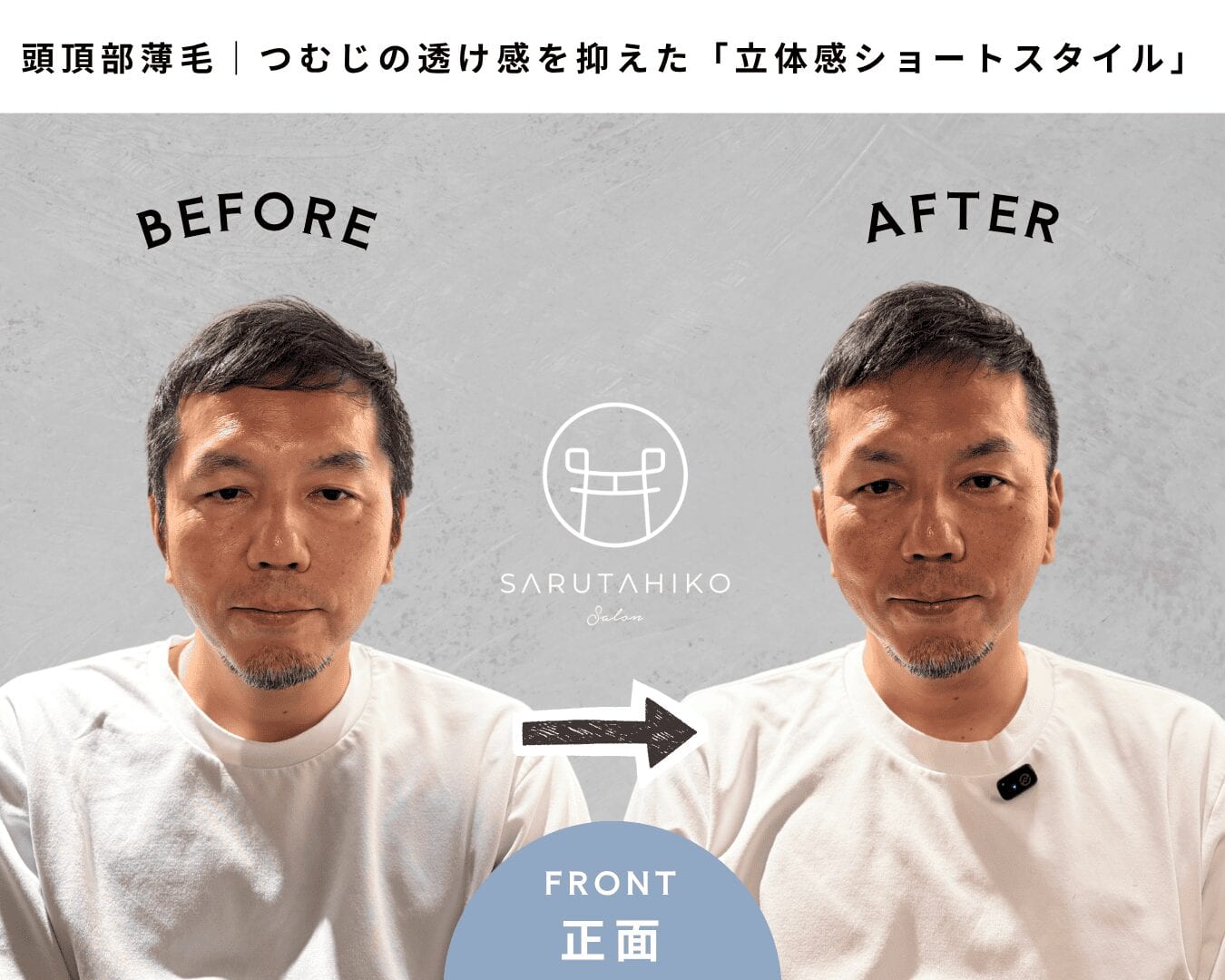
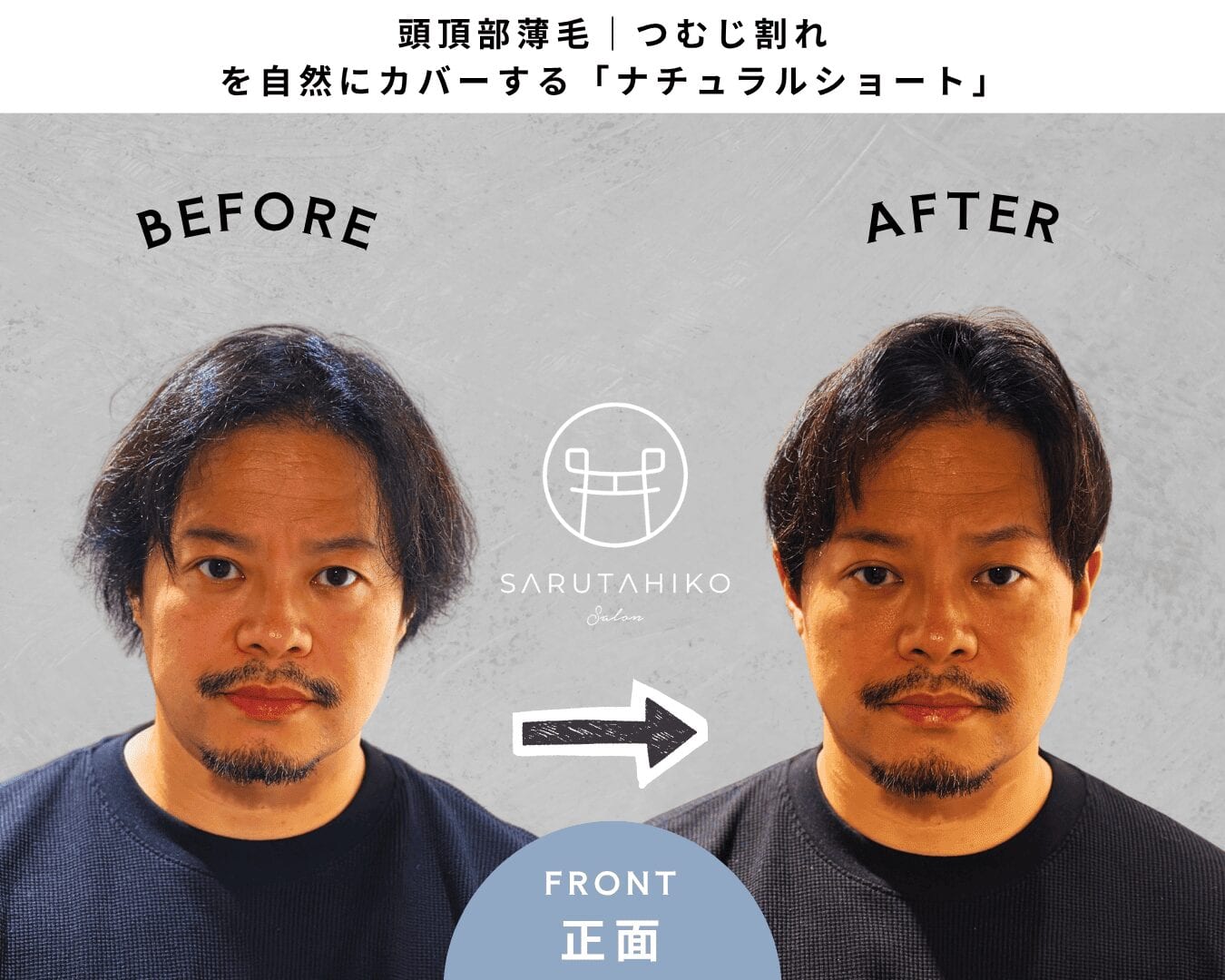
The result is a natural short cut: clean around the ears and the sides, with length and weight kept on top.
Unlike before,there is no longer any need to bring a mass of hair over from the other side, and both whorls sit quietly within the natural flow.
Looking at the finish, he said:"That looks natural." "It looks really good."That was what he told us.
Before the cut, covering one side opened the other. Leaving the hair each area needs has given a finish that does not look like it is hiding anything.
To make thinning hair look natural, sorting out which hair goes where often matters more than growing a lot of it and laying it over.
Later on, a perm is another way to build a natural flow
In the consultation we also talked about where his hair might go next.
He is also interested in something that suits his beard:a wilder, grown-up permed style with a bit of edge to it.
At the current length, sorting out the flow as we did today is the right approach. In another two or three months of growth, a permed style becomes easier to consider.
With a perm, the hair curls and overlaps rather than parting in a straight line.
So even if a whorl or a parting shows a little, it can look more natural than straight hair splitting in a clean line.
We plan to let it grow and look at a permed style depending on how the hair is and what he wants.
What a barbershop for thinning hair can offer
At SARUTAHIKO we look beyond the pattern — M-shape, O-shape, horseshoe — to where the whorls are and how many there are, how fine the hair is and which way it falls, and propose the style from there.
Rather than simply laying hair over a thin area, as here, we think about
- which hair to use for cover
- which lengths to keep
- where to cut shorter to adjust the weight
- which way to dry it
so that the style is one you can reproduce at home.
"My whorl splits and the scalp shows."
"Cover one side and another looks thin."
"The wind undoes the whole thing."
"I want to enjoy longer hair and still look natural."
If any of this sounds like you, come and talk to us at SARUTAHIKO.


Watch the video: a natural short cut that covers a double whorl, for a man in his 40s
The video shows what photos cannot fully convey: the hair flow at the crown and the overall silhouette. If you are concerned about a double whorl, please use this case as a reference.

If the video does not play, use this link: Watch the haircut video on YouTube
FAQs
- Can thinning be covered naturally even with two whorls?
- The approach depends on how much hair there is and where the whorls sit, but as here, keeping the hair each whorl needs and sorting out the flow can make it far less noticeable.
- Should I grow my hair long to cover thinning at the crown?
- Longer is not always better. Bringing long hair right across from the other side was exactly what made another area split. Keep the length where it is needed and tidy the rest.
- How should I style it at home?
- With this style, dry the crown from back to front, then settle the flow with a comb. It is designed so you rarely need to pick out strands and drag them across as before.
- Does a perm help with a split at the whorl?
- Depending on the length and condition of your hair, it is an option. We suggested that this client grow it a little longer and then use a perm to build flow and overlap. What suits varies from person to person, so we decide by looking at the hair.